Loading...


GUIDE FOR BUSINESSES
Payment Demand Letter in Poland - Template, Rules & When to Send [2026]
A payment demand letter is a formal written request sent to a debtor requiring payment of an outstanding amount by a specific deadline. It is a key step in the debt recovery process - used when earlier reminders have gone unanswered. This guide explains when and how to send one, what it must contain, and what your options are if the debtor still doesn't respond.
What Is a Payment Demand Letter?
A payment demand letter is a formal, written request from a creditor to a debtor demanding settlement of an outstanding debt. The document confirms the existence of the obligation, specifies the amount owed including any accrued interest, and sets a new payment deadline - typically 7 or 14 days from the date of receipt. Unlike an informal payment reminder (such as a polite email asking a client to settle an invoice), a payment demand letter is a formal document that can be used as evidence in legal proceedings.
Polish law does not require a creditor to send a demand letter before filing a lawsuit, but its absence can be procedurally disadvantageous - a court may ask whether the creditor attempted an amicable resolution before resorting to litigation (Article 187 § 1 item 3 of the Code of Civil Procedure). It is also worth distinguishing between a standard payment demand and a pre-litigation demand: the latter is sent as the final step before court action and includes an explicit warning about the consequences of non-payment. Both documents serve a similar purpose, but a pre-litigation demand carries greater weight and signals that the creditor is fully prepared to escalate.
Legal Requirement: Article 187 § 1 Item 3 of the Polish Code of Civil Procedure
“The statement of claim should contain [...] information on whether the parties have attempted mediation or another out-of-court settlement, and if no such attempt was made, an explanation of why.”
Since 2016, Polish courts require claimants to confirm in their lawsuit that they attempted an amicable resolution before filing. A payment demand letter fulfils this requirement — it is proof that you tried to recover the debt without involving the court. Failing to send a demand letter can result in being ordered to pay the opposing party's legal costs, even if you win the case.
When Should You Send a Payment Demand Letter?
When the due date has passed and reminders haven't worked
The first step after a missed payment deadline is usually an informal reminder - an email or SMS. If the debtor still hasn't responded after one or two reminders, it's time to escalate to a formal payment demand. The shift in tone and format sends a clear signal that you are treating the matter seriously.
Before taking legal action
Although a payment demand letter is not a legal prerequisite before filing a lawsuit in Poland, courts view creditors more favourably when they have documented attempts to resolve the dispute amicably. Without such documentation, proceedings may be longer or more complicated.
When you want to formally document your claim
A formal payment demand creates a paper trail: it confirms that the debtor was aware of the obligation, knew the exact amount owed, and had a genuine opportunity to settle voluntarily. This documentation is invaluable if the dispute eventually moves to court or external debt collection.
When dealing with a habitual late payer
If a client consistently pays late, sending a formal demand - even for relatively small amounts - signals a change in approach. This alone often motivates behavioural change and prompts timely payment without the need for further escalation.
Is a Payment Demand Letter Mandatory?
A payment demand letter is not formally required in every situation — but in many cases, failing to send one can cost you.
When it is required
- Electronic Writ-of-Payment Proceedings (EPU / e-Sąd) — required as proof of an attempted amicable resolution
- Summary proceedings — the court verifies whether a pre-litigation attempt was made
- Allocation of legal costs — without a demand letter you may be ordered to cover costs even if you win (Art. 101 CPC)
- Public procurement contracts — contracting authorities require a formal demand before any escalation
When it is best practice
- B2B transactions — professional debt recovery procedure
- Long-term trade relationships — formalises the claim without damaging the business relationship
- Small amounts (up to PLN 5,000) — faster and cheaper than going to court
- Invoices with short delays (up to 14 days) — a reminder alone resolves the issue in 70% of cases
What Must a Payment Demand Letter Contain?
A properly drafted payment demand letter should include all of the following elements to be effective both as a debt recovery tool and as evidence in potential legal proceedings.
1
Creditor and debtor details
Full company name (or full name for individuals), registered address, and VAT/tax identification number for both parties. The document must unambiguously identify who is demanding payment and from whom.
2
Invoice number and amount owed
State the specific invoice number (or numbers), its issue date, and the original payment due date. Show the principal amount and any accrued interest as separate line items.
3
New payment deadline
Set a specific new payment deadline - typically 7 or 14 days from the date of receipt. The deadline should be realistic but clearly defined, with no room for ambiguity.
4
Bank account details
Provide the account number to which payment should be transferred. Ensure it matches the account shown on the original invoice, or explicitly state that bank details have changed.
5
Interest calculated to date
State the legal basis for interest (typically statutory interest for delay in commercial transactions under the Act of 8 March 2013) and the amount of interest accrued as of the date of the letter.
6
Consequences of non-payment
Inform the debtor that failure to pay by the stated deadline will result in court action or referral to a debt collection agency. Clearly articulating consequences significantly increases the effectiveness of the demand.
7
Date and signature
The letter must be dated and signed by a person authorised to represent the creditor, or include a named stamp in the case of an electronic document.
Don't write it by hand - generate a correct demand in 2 minutes
How to Deliver a Payment Demand Letter — Methods and Proof
The delivery method matters. In a court dispute, you must be able to prove that the debtor had the opportunity to read the letter.
Registered post with return receipt
Pros
- Strongest proof in court
- Signed delivery confirmation
- Certain date of delivery
Cons
- Cost ~PLN 8–12 per letter
- Delivery takes 2–5 days
- Debtor may refuse delivery (but the notice of attempted delivery still counts)
Highest evidentiary value
Email with read receipt
Pros
- Instant delivery
- No cost
- Easy to archive
Cons
- Lower evidentiary value
- No certainty it was read
- May go to spam
Medium evidentiary value
Recommended
Combined approach (recommended)
Pros
- Maximum effectiveness
- Two delivery channels
- Full documentation trail
Cons
- Requires preparing two versions
Recommended by Terminovo
Payment Demand Templates — Three Escalation Levels
The tone of your demand should match the situation. Below are sample texts for three typical scenarios.
Polite reminder1–7 days overdueFriendly
Dear Sir/Madam,

We would like to kindly remind you that invoice no. [NUMBER] dated [DATE] for the amount of [AMOUNT] PLN fell due on [DUE_DATE]. We kindly ask you to settle this payment within 7 days.

Should you have any questions, please do not hesitate to contact us.

Yours sincerely,
[COMPANY]
Generate this template in the generator
Firm demand14–30 days overdueFormal
Dear Sir/Madam,

We hereby request immediate settlement of overdue invoice no. [NUMBER] dated [DATE] for the amount of [AMOUNT] PLN. The payment deadline of [DUE_DATE] has passed, meaning the invoice is now [NUMBER] days overdue.

Pursuant to the Act of 8 March 2013, we are charging statutory interest for delay in commercial transactions (13.75% per annum) as well as a flat-rate recovery cost reimbursement of [40/70/100] EUR.

Please arrange payment within 7 days of receiving this letter.

Yours sincerely,
[COMPANY]
Generate this template in the generator
Final pre-litigation demand30+ days overdueWarning
FINAL PAYMENT DEMAND

Dear Sir/Madam,

We hereby make a final demand for payment of [AMOUNT] PLN in respect of invoice no. [NUMBER] dated [DATE], together with statutory interest for delay in commercial transactions of [INTEREST_AMOUNT] PLN (accrued from [DUE_DATE] to today's date) and a flat-rate recovery cost reimbursement of [40/70/100] EUR.

Total amount due: [TOTAL] PLN.

Deadline: 7 days from the date of receipt of this letter.

Failure to pay within the above deadline will result in legal proceedings being initiated without further notice.

[COMPANY]
Generate this template in the generator
Don't Forget Your Flat-Rate Recovery Cost Reimbursement
In addition to interest, B2B creditors in Poland are entitled to a flat-rate reimbursement: EUR 40 (up to PLN 5,000), EUR 70 (PLN 5,000–50,000), or EUR 100 (above PLN 50,000). Find out how much you're owed.
Escalation: From Reminder to Pre-Litigation Demand
1
First payment reminder
1–3 days after due dateA short, polite email or SMS reminding the client about an upcoming or recently missed payment deadline. The tone is friendly - the assumption is that this is an oversight, not deliberate non-payment. The goal is a quick resolution with no need to escalate.
2
Second reminder - firmer tone
7–10 days after due dateA follow-up message clearly stating the overdue amount and the interest already accruing. The tone is direct and professional, but remains courteous. The debtor is informed that the matter will be escalated if payment is not received promptly.
3
Formal payment demand letter
14–21 days after due dateA written, formal payment demand containing all required legal elements. Sent by registered post and/or email with delivery confirmation. This document serves as evidence that the creditor made a genuine attempt to recover the debt amicably.
4
Pre-litigation demand letter
30–45 days after due dateThe final step before court. This so-called final payment demand contains an explicit warning: if the debt is not settled within the stated period, the creditor will initiate legal proceedings or refer the case to enforcement. It signals that the creditor is fully committed to taking action.
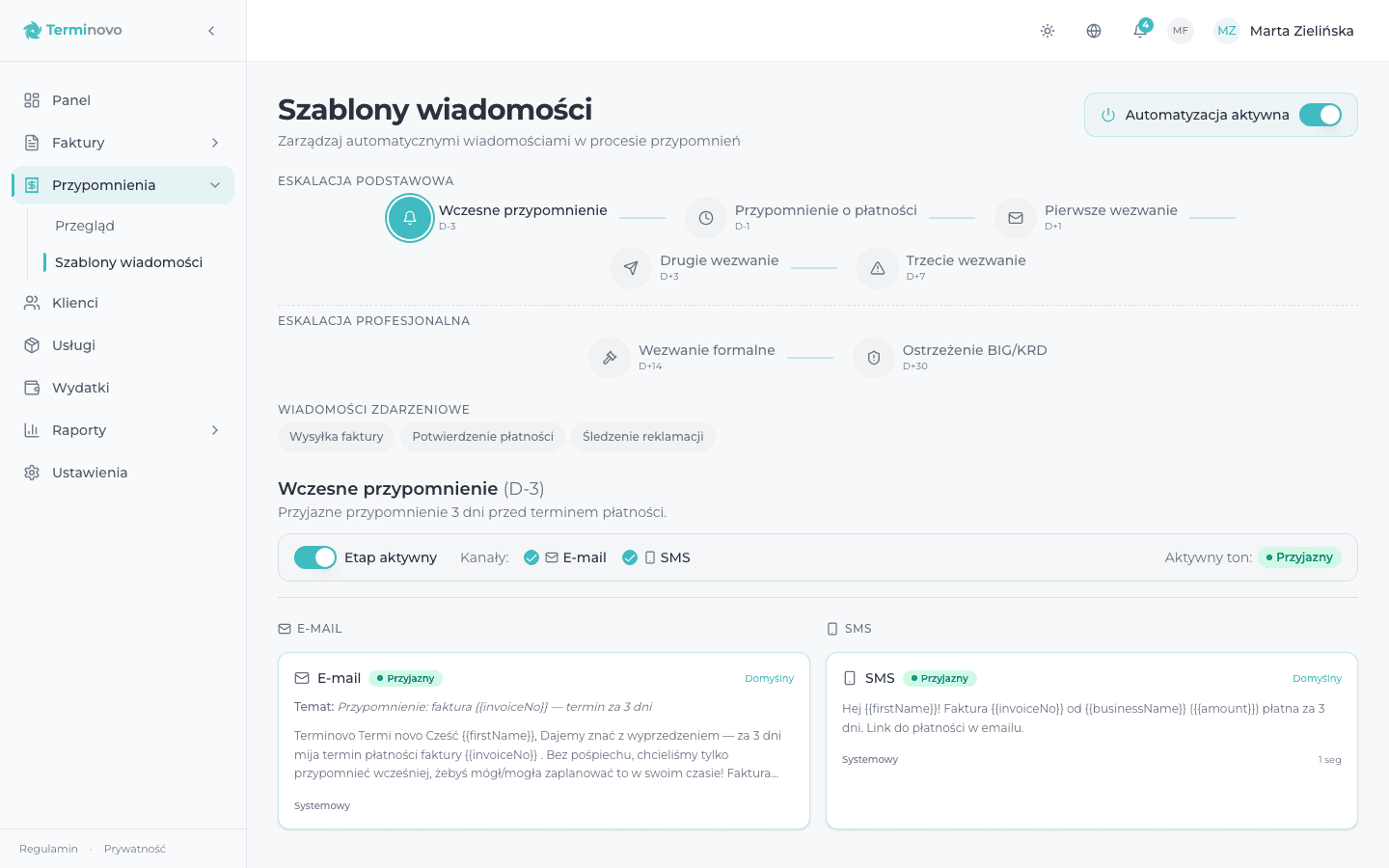
Terminovo automates every step of this escalation
Set up the sequence once - reminders and demands are sent automatically.
Start for Free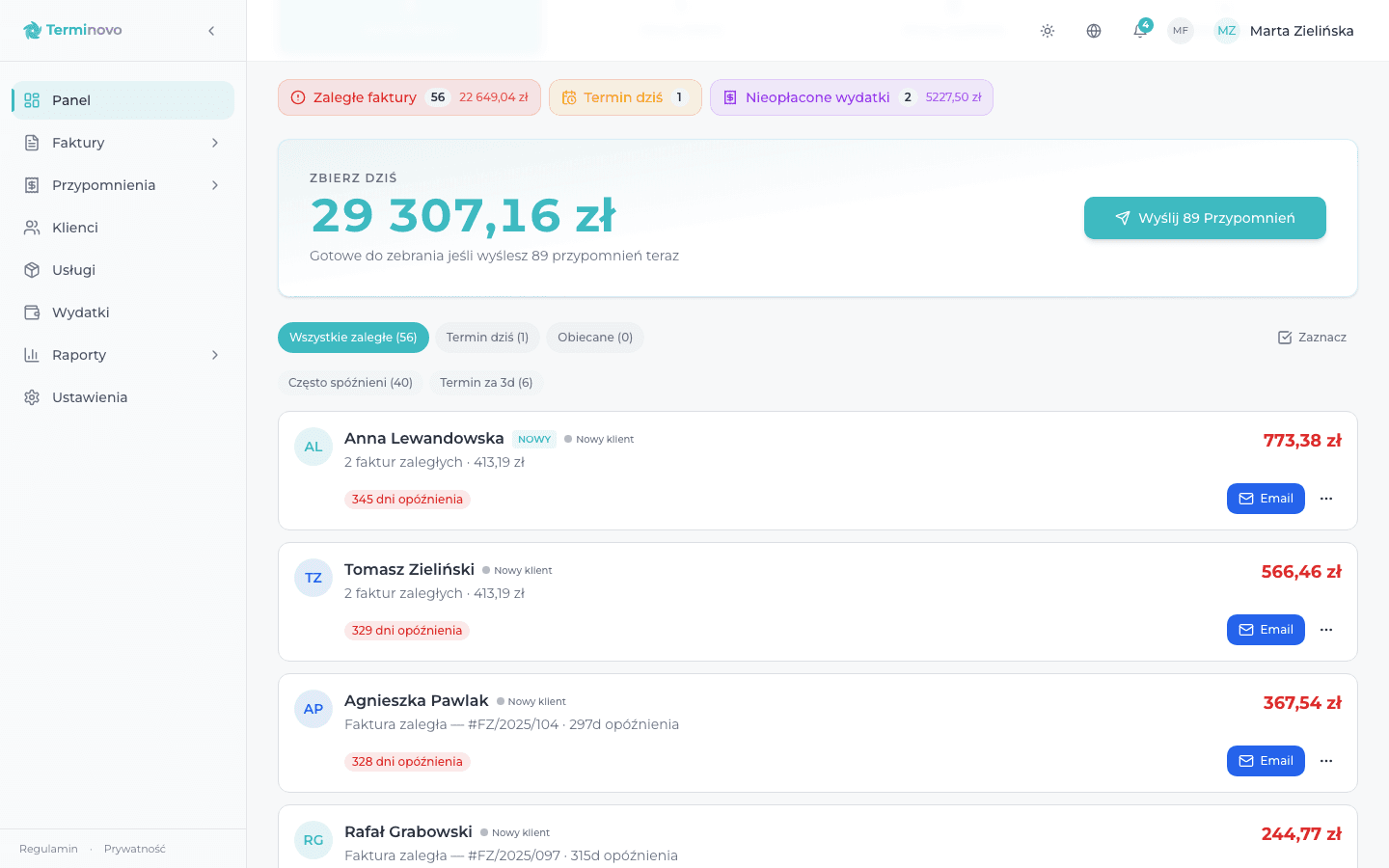
What Is a Pre-Litigation Payment Demand and When Should You Use It?
A pre-litigation payment demand (also referred to as a final payment demand) is a letter sent to the debtor as the last step before filing a lawsuit or referring the case to external debt collection. It differs from a standard payment demand primarily in tone and in the explicitness of its warning: if the outstanding amount is not settled within the stated deadline (typically 7 days), the creditor will take legal action. The document should contain all the elements of a formal payment demand, with the addition of a clear statement of the planned next steps - filing a claim with the district or regional court, using the Electronic Writ-of-Payment Proceedings (EPU), or engaging a debt collection agency.
From a procedural standpoint, Article 187 § 1 item 3 of the Polish Code of Civil Procedure requires the claimant to state in the lawsuit whether they attempted mediation or another out-of-court resolution, and if not - to explain why. Having a pre-litigation demand with proof of delivery demonstrates that the creditor acted in good faith and gave the debtor a genuine opportunity to settle voluntarily. The absence of such documentation does not prevent a creditor from winning a case, but it can prolong proceedings and may negatively affect the court's decision on the allocation of legal costs.
Frequently Asked Questions
Is a payment demand letter legally required before going to court in Poland?
No - Polish law does not impose a formal obligation to send a payment demand before filing a lawsuit. However, Article 187 § 1 item 3 of the Code of Civil Procedure requires the claimant to state in the lawsuit whether an attempt was made to resolve the dispute amicably. The absence of a demand letter does not block proceedings, but it can negatively influence the court's assessment and its decision on legal costs.
How long should I give the debtor to pay after sending the demand?
The standard is 7 or 14 days from the date of receipt. A 7-day deadline is typically used for pre-litigation demands, where speed matters. A 14-day deadline is more common for the first formal demand - it gives the debtor a reasonable opportunity to respond and gather funds. An excessively short deadline (e.g. 2–3 days) may be considered inadequate by a court.
Should I send a payment demand by registered post or email?
The most effective approach is to send it through both channels simultaneously: by registered post with return receipt (providing proof of delivery) and by email with a read receipt request. Email alone may be challenged as proof of delivery unless you have confirmation that the address was used in prior business correspondence. A registered letter is harder to dispute in court.
What should I do if the debtor doesn't respond to the payment demand?
If the debtor neither responds nor pays after the stated deadline, the next step is to file a claim in court (e.g. via summary proceedings or the Electronic Writ-of-Payment Proceedings - EPU) or refer the case to a debt collection agency. Having documentation - demand letters with proof of delivery - significantly speeds up and simplifies legal proceedings.
Can I charge the debtor for the cost of sending the payment demand?
Yes. Under the Act of 8 March 2013 on counteracting excessive delays in commercial transactions, creditors are entitled to a flat-rate recovery cost reimbursement of 40, 70, or 100 euro depending on the value of the claim. This amount can be included directly in the payment demand as a separate line item.
What is the difference between a payment demand letter and an interest note?
An interest note is an accounting document issued by the creditor to formally record and charge the debtor for accrued late-payment interest. A payment demand letter is a debt recovery document - a formal request for full settlement of the outstanding obligation (principal + interest + any recovery costs) by a specified deadline. Both documents can be sent simultaneously, or the interest note can be attached as an appendix to the payment demand.
Can you send a payment demand by email?
Yes, a payment demand letter can be sent by email, but the evidentiary value is lower than that of a registered letter. An email will be accepted as proof of delivery if you have a read receipt or prior business correspondence confirming the address. For full legal certainty, we recommend combining both channels: email for immediate contact and registered post as the official legal record. A demand sent by email alone may be disputed by the debtor on the grounds that it was never received.
What's the difference between a payment demand and a pre-litigation demand?
A payment demand is the broader term — it covers any formal written request for payment, at any stage of the collection process. A pre-litigation demand (or final payment demand) is a specific type sent as the last step before filing a lawsuit. It includes an explicit warning that legal proceedings will be initiated if payment is not received by the stated deadline, and the creditor must follow through. In practice, every pre-litigation demand is a payment demand, but not every payment demand is a pre-litigation demand.
Does a payment demand interrupt the statute of limitations?
Sending a payment demand letter alone does not interrupt the statute of limitations under Article 123 of the Polish Civil Code — interruption requires a procedural act (such as filing a lawsuit or a motion for a conciliation hearing) or acknowledgement of the debt by the debtor. However, a demand letter can support the argument that the creditor was not passive about the claim. If the limitation period (3 years for business claims) is approaching, do not rely on demand letters alone — file a claim or initiate a conciliation motion to actually stop the clock.
What to do when the debtor disputes the claim?
If the debtor contests the validity of the claim (e.g. alleging goods were not delivered or a service was defective), do not reduce the claimed amount in the demand letter — the creditor determines the amount. Instead, attach copies of supporting documents: the invoice, delivery note, service confirmation, or signed contract. If the debtor raises a formal complaint, set a parallel deadline for its resolution without waiving the payment deadline. Where there is a genuine factual dispute, consider mediation or court proceedings where evidence can be formally examined.
Can you send a payment demand to an individual consumer (B2C)?
Yes, payment demand letters can be sent to both businesses and private individuals. However, when dealing with consumers, note that the flat-rate recovery cost reimbursement of EUR 40/70/100 applies exclusively to commercial transactions between businesses — it does not apply in B2C situations. Late-payment interest is charged at the general statutory rate (not the commercial rate), and the limitation period is 6 years for unprescribed claims. The tone and content of a demand addressed to a consumer should comply with applicable consumer protection regulations.
How to write a payment demand in English?
A payment demand in English is typically addressed to foreign contractors from the EU or beyond. The document should contain the same elements as a Polish demand: party details, invoice number, amount, deadline, bank account, and consequences of non-payment. It is advisable to specify the governing law (e.g. Polish law under the contractual clause) and the language of any legal proceedings. For EU counterparties, you may reference EU Regulation Rome I on applicable law. Terminovo's demand generator allows you to create a compliant English-language document that meets Polish legal requirements.
Automate Your Payment Reminders and Demands
Terminovo automatically sends reminders and payment demand letters at exactly the right moment - before things ever reach a courtroom. Set up your escalation workflow once, and let the system handle the rest.
Generate a Demand for FreeWant to automate the entire process? Create an account - reminders and demands send themselves